Are you accessing this website using an Android phone?
If yes, the stress is over, just click the below button to download and install our Android app and we will hence bring the news to your doorstep.

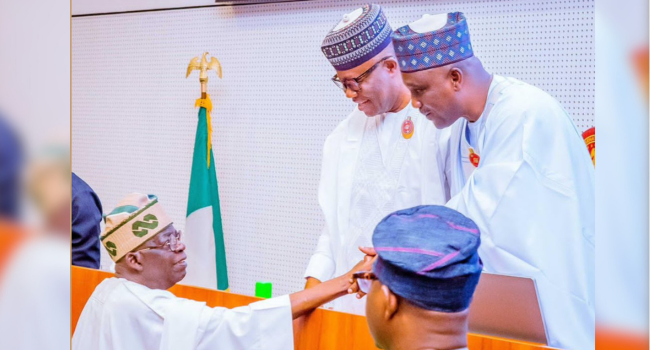
President Bola Ahmed Tinubu has made a dramatic move that could reshape Nigeria’s economic direction, formally asking the National Assembly to approve a staggering ₦9 trillion increase to the already massive 2026 budget — a proposal that signals both urgency and ambition at the heart of his administration.
The request, transmitted to lawmakers, is not just about adding more money to government spending. It is part of a broader strategy to recalibrate Nigeria’s fiscal framework, plug execution gaps, and force a long-overdue end to the chaotic tradition of overlapping budgets that has plagued the country for years.
At the center of the proposal is Tinubu’s determination to align government spending with current economic realities. His administration argues that previous budget assumptions no longer reflect the pressures facing Africa’s largest economy — from inflation and exchange rate volatility to rising debt obligations and security demands. The additional ₦9 trillion is expected to accommodate these shifts while boosting critical sectors.
This development comes on the heels of the President’s earlier presentation of a ₦58.18 trillion 2026 appropriation bill — one of the largest in Nigeria’s history — designed to drive “renewed resilience and shared prosperity.” The budget itself is anchored on ambitious projections, including improved oil revenues, controlled inflation, and stronger fiscal discipline, even as the country faces a projected deficit running into trillions of naira.
But beneath the numbers lies a deeper story: a government racing to fix structural inefficiencies in how Nigeria spends money. For years, delayed budget approvals and poor implementation meant multiple fiscal cycles overlapped, weakening accountability and slowing down capital projects. Tinubu’s latest push is aimed squarely at ending that cycle.
Insiders say the proposed increase will likely be channeled into infrastructure, security, and key development projects, areas that have consistently consumed the largest share of federal spending. With debt servicing already taking a significant bite out of national revenue, the move also raises fresh questions about sustainability — and whether Nigeria can balance aggressive spending with fiscal prudence.
The President has defended the plan as necessary and strategic, insisting that disciplined execution — not just higher spending — will define the success of the 2026 budget. His administration is betting that a more realistic and responsive budget framework will unlock growth, restore investor confidence, and stabilize the economy.
Still, the proposal now sits in the court of the National Assembly, where lawmakers hold the power to approve, adjust, or even challenge the increase. Historically, Nigeria’s parliament has not hesitated to alter budget figures, sometimes increasing allocations beyond executive proposals.
As debates begin, one thing is clear: this is more than a routine budget adjustment. It is a high-stakes fiscal gamble that could define Tinubu’s economic legacy — and determine whether Nigeria’s long-promised era of disciplined, effective governance finally becomes reality.
Join Our WhatsApp Channel
DEAR READER,
Good journalism costs a lot of money. Yet only good journalism can ensure the possibility of a good society, an accountable democracy, and a transparent government. For continued free access to the best investigative journalism in the country, we ask you to consider making modest support to this noble endeavor. By contributing to The Trumpet News, you are helping to sustain journalism of relevance and ensuring it remains free and available to all. Your donation is voluntary — please decide how much and how often you want to give.
For offline donations, email donations@thetrumpetngr.com or call +2347026891070:
You May Also Like This...